LATEST INSIGHTS
Tasman Capital Partners Fund IV reaches first close and completes initial investments


Carbon reporting that turns data into action
We sat down with Richard James, Head of UK, to explore how better data drives better decisions. In partnership with Alectro, we now have clearer visibility of Scope 1–3 emissions across the group, helping us focus on the levers that matter most. The result: practical change and measurable progress, including a 10 per cent reduction in emissions per employee between 2023 and 2025.
Q1. Why does carbon reporting matter to Langham Hall?
It gives us clarity. With accurate Scope 1–3 data we can see the biggest levers and prioritise actions that reduce emissions and create value.
Q2. What has changed since partnering with Alectro?
We have end-to-end visibility through the Virtual Sustainability Officer platform and a simpler workflow for data collection. That has supported a 10 per cent reduction in emissions per employee between 2023 and 2025, driven by practical improvements across travel, procurement and resource use.
Q3. Where does the data make the biggest difference day to day?
In decision-making. Teams can compare options with a common dataset and select the route that delivers the best outcome for the environment and the business.
Q4. What sets Alectro apart in your view?
Integration and interpretation. The platform fits how we work and the team helps translate complex data into actionable insight. That combination accelerates progress.
Q5. What is next for our ESG programme?
Continual improvement. We will expand data coverage, refine reporting and focus on initiatives with measurable impact. The aim is simple: keep turning insight into action.

Fair value, not fairy tales: how investors test your numbers
Fair value is not an abstract accounting exercise. It is a practical tool for investor protection and decision-making. In Asia today, with fundraising cycles lengthening and audits tightening, LPs are testing whether managers’ numbers stand up to scrutiny.
For asset owners, from pensions and insurers to banks and corporates, the question is simple: does today’s valuation help me manage risk, allocate capital and communicate clearly?
For managers, this requires moving beyond a “manager’s mark” mindset. Investors increasingly expect valuation processes that minimise discretion, separate duties between deal teams and valuation oversight, and evidence external challenge where appropriate. Advisory boards are asking sharper questions. Many global LPs favour independent inputs or third-party reviews to remove conflicts and drive consistency across portfolios.
Why now in Asia? Fundraising cycles have lengthened, audits are probing methodology and data provenance, and cross-border investors compare outcomes across jurisdictions. Japan’s market is also shifting: international allocators increasingly expect fair value as standard, not a nice-to-have. In this context, the objective is alignment: a valuation approach that investors trust because it is explainable, repeatable and evidence-based.
A pragmatic framework helps:
- Governance: clear separation of origination and valuation oversight; documented challenge and sign-off
- Methodology: consistent techniques (market, income, cost) with rationale for selection and key assumptions
- Evidence: multiple sources, audit trails, and direct company data validated where possible
- Materiality and frequency: focus effort where it changes decisions; refresh in line with risk and liquidity
- Communication: translate methods and outcomes into investor-relevant insights (risk, runway, cash, progress to value-creation plan)
For GPs, fair value done well reduces friction in audits and LP conversations, shortens diligence cycles and strengthens credibility in a competitive fundraising environment. For LPs, it supports asset-liability management and comparability across managers.
At Langham Hall, we help managers design and operate valuation and reporting processes that meet international expectations while remaining practical for Asian portfolios.

British Business Bank announces partnership with Langham Hall to support delivery of British Growth Partnership Fund I
Langham Hall welcomes today’s announcement from the British Business Bank naming Langham Hall as a partner to support delivery of British Growth Partnership Fund I. Langham Hall will provide fund administration, depositary and alternative investment fund management (AIFM) services, subject to final terms and relevant approvals.
Announcement (from the British Business Bank):
- First close of £200m targeted by end of the financial year, enabling the initial fund to begin investing into high growth UK companies
British Business Bank announces Aegon UK, NatWest Cushon and M&G as its partners for the targeted first close of British Growth Partnership Fund I, subject to final terms and relevant approvals - The British Business Bank has announced that Aegon UK, NatWest Cushon, and M&G are the partners for the first close of the British Growth Partnership Fund I, subject to final terms and relevant approvals.
The British Business Bank has announced that Aegon UK, NatWest Cushon, and M&G are the partners for the first close of the British Growth Partnership Fund I, subject to final terms and relevant approvals.
All parties have now completed investment diligence and are finalising terms and structuring. The Bank is targeting a first close of £200m by end of the financial year, enabling the fund to begin investing into high growth UK companies in 2026.
The Bank continues to work with other investors, including London CIV. In May, London CIV became the first LGPS pool to announce its intention to work with the Bank on the launch of the British Growth Partnership, and discussions are ongoing regarding a potential investment into the fund.
Announced at the International Investment Summit, the British Business Bank is establishing the British Growth Partnership, encouraging more UK pension fund and other institutional investment into the UK’s fastest growing, most innovative companies. The initial fund will seek to raise hundreds of millions of pounds, including a commitment from the British Business Bank, to invest in some of the highest potential opportunities in the Bank’s venture capital pipeline.
Louis Taylor, CEO, British Business Bank said: Today’s announcement brings us one step closer to mobilising institutional capital at scale into the UK’s fastest growing companies, both diversifying pension portfolios and providing much needed scale up funding.
The British Growth Partnership will provide access to the Bank’s live pipeline of scale up businesses, providing a vital bridge between institutional investors and the UK’s thriving venture capital sector. We are making strong progress with our initial fund and this news demonstrates the appetite across the full spectrum of pension funds to increase allocations to UK venture capital.
M&G, an international leader in savings and investments with £365bn in assets under management, has agreed to partner with the British Business Bank on the launch of the British Growth Partnership, with a view to making an investment at first close, subject to finalising terms and structuring.
Alex Seddon, Head of Impact and Private Equity, M&G Investments, said: We’re delighted to be partnering on this important UK growth initiative. Our commitment will build on the £100 billion we already invest in the UK economy and power up the next generation of high growth UK companies.
Britain’s businesses need patient capital to truly scale. By attracting more investment, the British Business Bank is taking a major step to drive dynamic growth and strengthen the UK’s position as a leading hub for innovation.
Aegon UK said: We are proud to be partnering with the British Business Bank on the launch of the British Growth Partnership. This initiative aligns with our commitment to supporting the UK’s most innovative and high-growth companies, while delivering long-term value for our customers.
NatWest Cushon said: As a signatory to both the Mansion House Compact and the Accord, we’re committed to directing investment into innovative, high-growth UK businesses and impact led sectors to deliver better outcomes for our pension savers whilst also supporting the UK’s growth ambitions. The British Growth Partnership is a vital step forward to unlocking these investment opportunities. The investment due diligence is complete, and we are excited to move forward subject to Trustee approval.
The Bank has also today announced partnerships with Langham Hall, an established provider of fund administration, depositary and alternative investment fund management (AIFM) services, to support delivery of BGP Fund I. Isio, a UK pensions, investments, employee benefits and wealth advisory business, also provided support and advice in creating and positioning the fund.
In November 2024, it was announced that Aegon UK and NatWest Cushon agreed to work with the new British Growth Partnership with a view to making investments in the initial fund. In May, the Financial Conduct Authority granted regulatory approval to BBB Investment Services Limited, the British Business Bank’s third-party arm, to provide investment services to clients.
The initial fund will have a direct investing strategy, co-investing alongside the Bank’s network of fund managers. The British Growth Partnership will leverage the Bank’s position as the most active late-stage investor into UK companies and the largest investor in UK venture and venture growth capital funds. Investments from the fund will be made on a fully commercial basis, independent of government, leveraging the Bank’s capability and market access to invest in a range of promising high growth UK companies.
In addition, the Bank has today announced it intends to launch a Venture Link initiative for pension funds. This will see the Bank publish enhanced information on its commitments to venture funds, as part of a package of measures to help pension funds to boost their investment capability, support them as they develop their strategy, reduce barriers to investment and help to unlock billions more in long-term investment for UK science, technology and innovation. The Bank will now consult with stakeholders on the design of this initiative.

Langham Hall supports Goldenpeak’s £375 million debut fundraise
Langham Hall has supported Goldenpeak on the successful first and final close of its debut private equity fund, Goldenpeak Fund I LP (the “fund”), at £375 million. The fund hit its hard cap and reached its close in just over 12 weeks from first conversations.
The fund will invest in professional services and data and information services businesses across the UK and Ireland. Founded in 2025 by Mark Williams and Leon Gillespie, Goldenpeak brings together a team with extensive experience from top-performing European private equity firms. The fund has secured commitments from a group of blue-chip US and European institutional investors.
Langham Hall’s team, led by Jon Young, Partner and Head of Guernsey, provides fund administration services from its Guernsey office and appointed representative (AR) services from its London office, supporting Goldenpeak through launch and close.
Goldenpeak was advised by Weil, Gotshal & Manges and Carey Olsen and has received fundraising support from Pacenote Capital.
"We are delighted to welcome Goldenpeak to our growing portfolio of first-time managers. This is an important milestone and we look forward to supporting the team beyond its very successful first and final close."
Jon Young, Partner and Head of Guernsey at Langham Hall

Continuation Vehicles: Operational Implications and the Actions that Matter
Continuation vehicles unlock LP liquidity while preserving ownership of high-conviction assets. But in our experience, many back offices were not designed for the resulting investor cohorts, economic exceptions and additional disclosures.
Why now
Dealmaking and liquidity are gradually returning. For many sponsors, continuation vehicles remain the most practical route to return capital, retain prized assets and align new capital with fresh horizons. The structures work; the strain is operational. Standard models assume a single LP cohort, uniform economics and one reporting cadence.
By the end of Q3 2025, secondaries had reached $165 billion in transaction value (including $60 billion in Q3 alone) and GP-led secondaries accounted for approximately 16% of sponsor exit volume, providing evidence that continuation vehicles are a mainstream solution rather than an edge case1. As a further indicator of momentum, there were approximately 105 sales to continuation vehicles year-to-date at that point, with the pace expected to continue2. Sponsors are sequencing continuation vehicles alongside delayed exits, while auditors and boards intensify scrutiny of carry history, valuation lineage and communications control.
There are, however, a number of operational considerations.
The operational problems: where we see back office issues
- Investor cohorts and rights - Rolling LPs, new entrants, stapled commitments (new money tied to future funds) and cross-fund participation create distinct investor cohorts with non-standard economics and side-letter terms. As a result, cap table logic fragments across spreadsheets, increasing error risk and delaying distributions.
- Waterfalls and carry - Historical data and mechanics must migrate exactly, including held-back amounts, legacy carry, true-ups and escrow. Any mismatch between old and new mechanics compounds at each distribution cycle and invites audit friction.
- Valuation lineage and governance - Legacy models meet new terms, voting and governance oversight. Without transparent lineage from assumptions to outputs, valuation debates restart every quarter.
- Quarter-end calendar risk - If interim checkpoints are weak, quarter-end becomes a catch-up exercise. Teams switch between migration clean-up and investor reporting, which extends the close.
- Communications load - Rolling LPs and new investors require different packs, narratives and timings. Version control becomes a risk of its own.
- Treasury and payments exposure - Manual payment files, ad hoc FX handling, and inbox-based approvals create control gaps and rework.
Problem, operational response and outcome
In our experience, each problem can be paired with a targeted operational response and a measurable outcome:
Investor cohorts and rights
- Operational response: Profile and clean the existing dataset; reconcile all cohorts to an agreed cut-off date, then review and validate distributions using migrated historical data, including held-backs, escrow and prior true-ups, before locking the tested engine to prevent off-model calculations.
- Outcome: Consistent preferences logic and no manual re-keying; reduces cohort-related reconciliation items by 30–50%.
Waterfalls and carry
- Operational response: Rebuild the carry engine from source principles (hurdles, catch-ups, lookbacks and allocation rules), then tie every variable back to migrated history. Test the engine with a full dry waterfall, including held-backs, escrow and prior true-ups, and reconcile outputs to the legacy model before cutover. Only then lock mechanics and prohibit off-model calculations.
- Outcome: Fully aligned carry mechanics and fewer reconciliation cycles; cuts time-to-first distribution by 1–2 weeks.
Valuation lineage and governance
- Operational response: Produce traceable evidence packs: inputs, model logic and outputs tied to the general ledger, with change logs.
- Outcome: Reviewers interrogate numbers rather than chase files; shortens valuation review cycles by 20–30%.
Quarter-end calendar risk
- Operational response: Insert defined gates (cap table, carry engine, valuation pack, communications) two to three weeks before quarter-end, each with a single accountable owner.
- Outcome: Shorter closes and fewer last-minute exceptions; brings quarter-end within target calendar two cycles in a row.
Communications load
- Operational response: Pre-build segmented packs for rolling LPs and new capital; enforce a content freeze so late changes recompute through the model rather than spawn new spreadsheets.
- Outcome: Accurate, on-time delivery; reduces investor Q&A volume by 20–40%.
Treasury and payments exposure
- Operational response: Generate payment files from the same core data; apply dual approvals and rule-based FX; keep critical steps out of inboxes.
- Outcome: Tighter controls and first-time-right payments; zero manual overrides on payment runs.
What an administrator should deliver (what ‘good’ looks like)
- One structured dataset, many views. A single, computable core of data powers every schedule and investor view; late changes recompute through the same model.
- Evidence as you go. Every material output traces to inputs and logic tied to the general ledger, with change logs and exam-ready evidence packs.
- Defined gates and owners. Cap tables, carry engines, valuation packs and investor communications are signed off before quarter-end, each with a single accountable owner.
- Speed with control. Live report generation and recomputation compress timelines without weakening governance.
- Multidisciplinary pods. Fund accounting, regulatory and company secretarial expertise resolve issues at source; treasury is aligned on payment controls.
- Migration discipline. Mid-cycle checkpoints and cutover plans that do not break quarter-end; dry waterfalls rehearsed before cash moves.
Actions to take before you launch
- Codify the economics for all investor cohorts; document exceptions early.
- Migrate with proof via a reconciliation pack that an auditor could sign today; include sample distributions and sensitivities.
- Rehearse distributions with a dry waterfall; fix mismatches before cash moves.
- Stabilize the calendar with interim gates for the first two quarter-ends; run weekly traffic reviews until BAU.
- Segment communications for rolling LPs and new capital; build real document sets and timelines, then test them.
- Name owners for cap tables, carry, valuation and investor communications; make escalation paths explicit.
Questions to answer before the board approves
- Have we agreed and documented all economic exceptions and side-letter impacts?
- Can we evidence the migration of carry history and prior true-ups?
- By what date can we dry-run and sign the first-distribution mechanics?
- Which investor cohorts require differentiated reporting, and when will those packs be ready?
- Where, if anywhere, do numbers leave the system and live in spreadsheets and what is our plan to eliminate or control those steps?
Conclusion
Continuation vehicles are no longer exotic, but they do need careful planning, as the issues are not the same as a normal fundraise: one structured dataset, examinable evidence, rehearsed mechanics and disciplined calendars.
[1] Ropes & Gray: Secondaries Q3 2025 Update
[2] NEPC, Quarterly Private Markets Report: Q3 2025
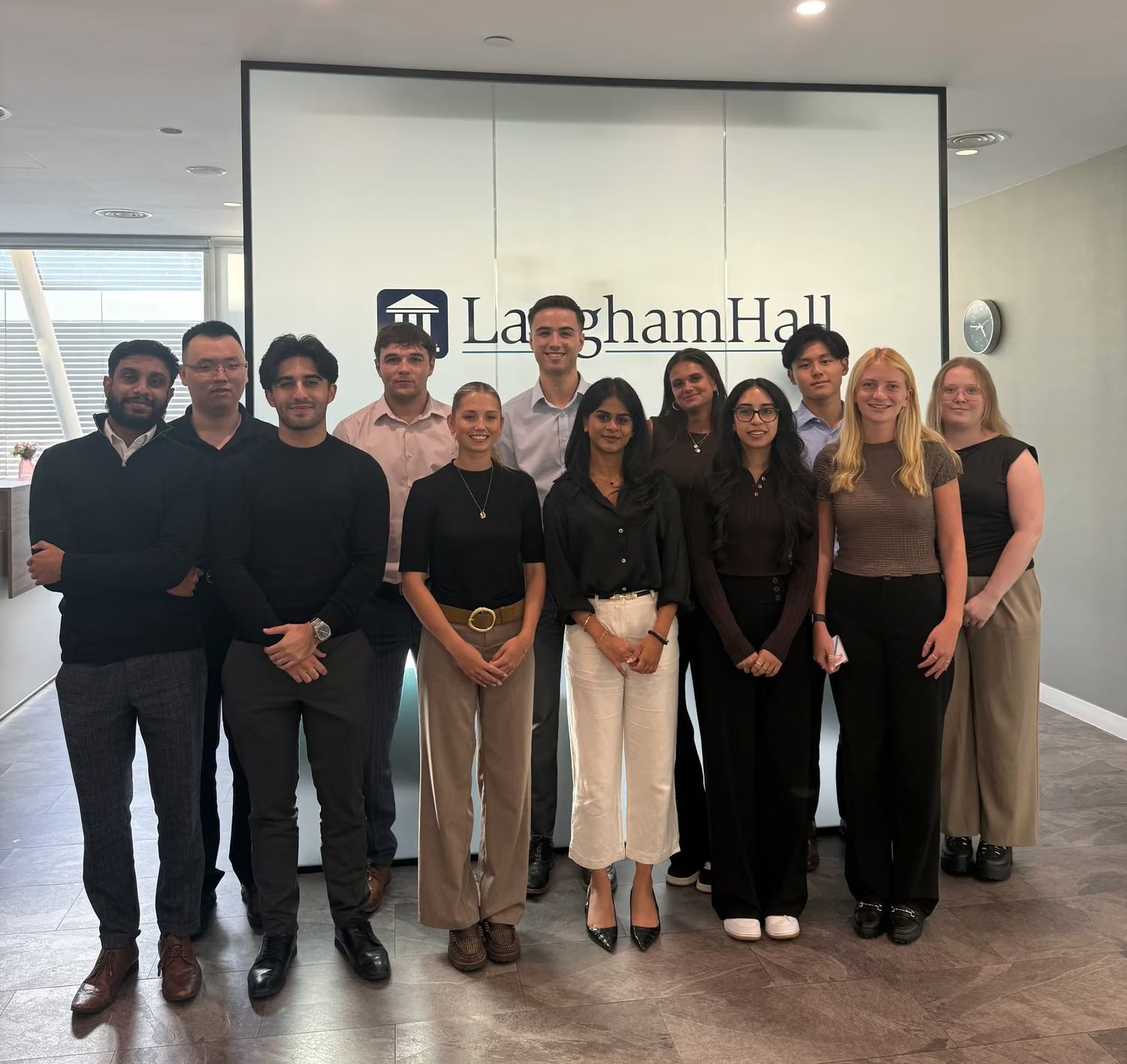
Graduate Spotlight: Two Months in with Priyankshi Chaudhary, Trainee Fund Accountant
How has the move from university to working life been?
The shift has been easier than I expected. Moving from a flexible timetable to a structured 9 to 5 took some adjustment, especially keeping my energy consistent through the day. What helped was realising the workday naturally breaks into manageable pieces, with clear priorities and regular check-ins. Once I found a routine, the transition felt smooth and motivating.
What excites you most about the next phase of your career here?
Building my network. I am meeting colleagues across teams, learning from senior leaders and beginning to gain client exposure. Each interaction builds confidence and context. Langham Hall creates many opportunities to learn on the job, ask questions and take on responsibility early, which makes the path ahead feel open and exciting.
What is one thing you wish you had known when you were applying or interviewing?
Be yourself. You are assessing the firm as much as the firm is assessing you. Prepare your questions and ask about the culture, the team and how people learn and progress. You will spend a lot of time here, so it should be a place where you can grow. And enjoy the process. Curiosity and authenticity come across well in any interview.

Career reflections: Alan O'Neill
Learning, leading and growing at Langham Hall
Alan O’Neill is part of Langham Hall’s Office of the Managing Partner, working across systems, efficiency and people development. He began his journey in our Real Estate team and has grown through client work and leadership roles over fifteen years.
Early lessons and real impact
I joined Langham Hall when the firm was in its early growth phase in London. I had worked in finance roles at large organisations but wanted to be closer to clients and to the work, making a visible difference. From day one, Langham Hall’s culture stood out: a professional services environment with immediate client exposure and clear accountability. I enjoyed seeing the direct impact of my work on clients and the firm. Those early years were fast-paced and full of learning. I studied for my CIMA qualification alongside colleagues who have since become lifelong friends.
Opportunities for development
Langham Hall’s commitment to development has been a constant throughout my career. Two years after joining, I began building my own team, passing on what I had learned and seeing others progress in their roles. That experience reinforced the importance of developing people and supporting them to take the next step.
As I moved into a Senior Manager role within the Real Estate team, I balanced client work with team leadership before stepping into a Director position. I continued to be involved in fund administration while also taking on broader projects across standardisation and systems. Working with HR, Operations, Technical and Payments teams gave me a wider view of how our internal tools support client service.
More recently, my role in the Office of the Managing Partner has centred on firm-wide initiatives around systems, efficiency and people development.
The apprenticeship model in practice: developing talent from within
The apprenticeship model has been central to Langham Hall since I joined. The firm has always invested in people and their development through consistent training, study support and structured mentorship. This approach builds confidence, skills and judgement.
I was fortunate to have exceptional mentors who guided me through early client interactions and helped refine my technical skills. The focus was on learning quickly, taking ownership and understanding how to ease the workload of those around me. Regular one-to-one sessions went beyond day-to-day tasks, offering space for feedback and development. That experience shaped how I now approach leadership and the time I invest in others.
Alongside on-the-job learning, I have benefitted from professional coaching and external training to prepare for senior roles. The greatest influence has come from senior colleagues who shared their time and experience, encouraging me to take on new challenges with confidence.
Advice for those starting their career
My advice to anyone starting out would be to embrace the opportunities that come with a growing business.
- Be curious, take initiative and step outside your comfort zone. The exposure you gain and the lessons you learn are invaluable.
- Maintain strong relationships with clients, colleagues and mentors. Our culture is built on collaboration and support, which makes the work rewarding.
- Focus on making life easier for the team around you; that mindset accelerates both learning and trust.
Reflections on the journey
The business has grown in ways that are almost unrecognisable from when I joined, yet our core values have remained constant. I am proud to have been part of that journey. The professionalism, commitment and shared ambition at Langham Hall are what make it such a special place to build a career.
Explore opportunities
Learn more about our trainee programme and experienced hire opportunities to develop your career at Langham Hall.

Langham Hall marks 10 years in Guernsey with 90-strong team as the island continues to attract private funds
Langham Hall has marked ten years in Guernsey with a team of more than 90 people and a clear commitment to keep investing in local talent and capacity as client demand grows.
Guernsey is a success story for private funds and for professional services careers. We see strong demand and a healthy pipeline across private funds strategies. Our aim is clear: invest in talent, raise the bar on quality, ensure direct access to senior people, and deliver at pace for managers who rely on us. With regulatory quality, investor confidence and efficient access to global investors, Guernsey is a natural hub for private funds
Market Momentum
Recent updates to Guernsey’s fund frameworks have made it faster and simpler to launch funds, particularly for first-time and emerging managers. We are seeing new mandates from both existing and first-time managers, adding breadth to Guernsey’s private funds ecosystem. That is supporting new work and bringing more opportunities to the island’s professional services community.
Ten years, strong foundations and a positive outlook
- Growth and scale: from a local launch in 2015 to a 90-strong team serving international clients from St Peter Port
- Client demand: predominantly private equity with growth in venture capital and real assets, supported by technology-enabled reporting and depositary capabilities
- International appeal: recognised regulatory quality, investor-friendly structures and efficient routes to global investors
- Local commitment: continued recruitment and clear career pathways in Guernsey to match client growth.
Langham Hall’s partner-led, owner-run model keeps senior people hands-on in delivery. The Guernsey team blends international expertise with local talent development to support complex, cross-border mandates. Since launching locally in 2015, the office has grown steadily and relocated to larger premises at Dorey Court, Admiral Park as the team has expanded.

Fairness in private asset funds: waterfalls and equalisation
Private asset funds are growing in prominence across Asia and with them comes renewed attention on how value is shared between managers and investors. Behind the headlines of performance and capital flows lies a critical question: fairness.
Fund structures are designed to align the interests of general partners (GPs) and limited partners (LPs), but conflicts emerge quickly when it comes to compensation. Carried interest, management fees, hurdle rates and equalisation provisions all determine who gets paid, when and on what basis.
Take waterfalls. Should carry be calculated on a deal-by-deal basis, allowing managers to take success fees on winning deals while losses remain uncovered? Or should the portfolio be viewed as a whole, with gains offsetting losses before performance rewards are crystallised? The difference is more than technical; it goes to the heart of whether LPs feel their capital is treated fairly.
Equalisation raises similar questions. Early investors often shoulder more risk, committing to a “blind pool” before investments are secured. Later investors may benefit from greater visibility. Without careful structuring, the cost of that timing can be borne unevenly, undermining the perception of fairness across LPs.
In Japan, standard contracts often lack some of the equalisation mechanisms seen in global markets. But international investors increasingly expect these protections as table stakes.
For GPs, the lesson is clear. Beyond strong returns, investor confidence depends on transparency, alignment, and fairness. These issues are not secondary: they are central to fundraising success.
At Langham Hall, we help managers design and operate structures that build lasting trust between investors and managers.
Join our newsletter
By subscribing you agree with our Privacy Policy