LATEST INSIGHTS
Tasman Capital Partners Fund IV reaches first close and completes initial investments


Tariffs, tensions and turbulence: Navigating fresh headwinds in private funds
Unease returns to fundraising conversations in private funds
Having just returned from ten days meeting clients and advisors in the US, it is clear the private funds industry is grappling with fresh headwinds just as recovery seemed within reach. The recent escalation of trade tensions following President Trump’s tariff announcements has significantly dented investor confidence, creating a ripple effect felt globally, with a noticeable chilling effect on capital commitments.
Signs of LP caution are emerging globally among fund managers
Whilst most fund launches remain broadly on track, there’s growing caution among limited partners (LPs). Across the industry, signs of hesitation and strategic pauses are emerging – not just in the US, but globally.
LPs are scaling back commitments, deferring decisions, or halting investments entirely. Danish investors, for example, particularly unsettled by geopolitical tensions surrounding Greenland, have notably reduced or delayed commitments. Just last week, one Danish LP halved its planned investment and another deferred its commitment to a later close.
In North America, several US endowments are expressing concern over potential changes to their tax status, with growing anxiety around reduced grant funding. And while not yet widespread, we are also seeing signs of increased internal scrutiny from Canadian investors, who are beginning to revisit their allocations and commitments. One prominent Canadian investor has frozen all new commitments, including re-ups, whilst the other has imposed a ban on employee travel to the US for work purposes.
Liquidity and pricing pressures mount for private funds
The ripple effect isn’t limited to fundraising alone. At the asset level, urgently needed liquidity is now under pressure. Inflation fears, coupled with ongoing policy uncertainty, have complicated asset pricing, further contributing to market inertia.
With investment programmes for 2025 already largely in place, the industry’s best short-term hope is a return to manageable volatility – conditions under which risk can be priced rather than feared.
Staying focused amid fragile sentiment in 2025
The coming months will be pivotal. Whilst the fundamentals of private capital remain robust, sentiment is fragile. Successfully navigating this period will require resilience, transparency and unwavering focus on long-term value creation.

Trends in venture capital fund terms report
As one of the only independent providers of fund administration and AIFMD services across three continents, our experience with venture capital clients makes us a valuable partner at set up stage and beyond. More recently, our use of Wolfram’s computable data technology has allowed us to give these GPs innovative management analytics alongside their regular reporting, including LP-by-LP performance data, as well as fund and asset level IRRs, all from one hierarchically stored central data source.
The report looks at:
- Management fees: including both during and after the investment period
- Carried interest: typical hurdle rates, as well as multiple vs IRR based calculations
- Super carry: how much and at what multiple this is payable
These findings were presented during a private dinner with Osborne Clarke’s Partner Helen Parsonage and Langham Hall’s Head of Commercial – Europe Tom Pinnell.
Langham Hall is delighted to present a research report on venture capital (‘VC’) fund terms, including trends in both management fees and carried interest. The report has been produced in conjunction with leading VC law firm Osborne Clarke, and contains data from over 60 European VC funds.

Graduate programme application – My experience of navigating the application process Q&A
Life after university can be overwhelming, especially with the additional pressure of choosing the right career path and landing a graduate role. In this Q&A, we speak to Alyssa Young and Madeleine Morgan, two of our September 2024 Graduate cohort, as they share their experiences of navigating the application process and securing positions as Trainee Fund Accountants. They also reflect on their first six months in the industry and discuss how they see their roles evolving in the future.
Whether you are considering applying or curious about the next steps once you have secured a graduate role, this Q&A provides insight into the experience of staring a career at Langham Hall.
Q: How did you decide what jobs to apply for after graduation? Did you always have a career path in mind?
MM: Navigating the vast number of post graduate career paths is overwhelming. I structured my job search by defining my key criteria and narrowing down the opportunities that met them. One of the most important factors was starting a role which was designed specifically for recent graduates and centred around structured training, a strong peer network and a clear path for professional growth. By focusing on this, among other qualities that I had priorities I refined my search to find a role that aligned with my long-term goals, ultimately leading me to Langham Hall.
AY: It initially felt quite overwhelming looking for jobs after university, especially as I did not have a clear career path in mind, and it felt difficult to know what opportunities to apply for. I knew that I wanted to work in the financial sector and the role of Trainee Fund Accountant really appealed to me as I didn’t need to have an in-depth knowledge of fund accounting prior to starting. One of the key factors I was looking for in a job was support throughout both the workday and studying for my professional qualifications; this was something that really stood out to me about Langham Hall.
Q: What degree did you do, and does it relate to your job?
MM: Whilst at university, I studied history because I wholeheartedly enjoyed the subject. While the content of my degree isn’t directly applicable to my day-to-day job, it provided me with a wealth of transferable skills. Studying history honed my attention to detail and ability to assimilate vast amounts of information – an essential balance when working with financial data and complex reports.
I wouldn’t say that deciding to study History rather than accounting or finance has hindered me in any way; if anything, it has given me a different perspective and sharpened my critical and analytical thinking.
AY: One of the parts I really enjoyed about my degree in maths and physics was the mix of theoretical and practical work, and I wanted to choose a career that replicated this. Whilst I did not have initial experience in accounting and finance when starting at Langham Hall, I have found that it has not held me back, and everyone in my team has been incredibly helpful and willing to answer any questions that I have no matter how many times I ask them.
Q: Why Langham Hall?
MM: There are three main factors which made me choose Langham Hall. Firstly, the apprenticeship model (‘learn on the job’ approach); the role allows graduates to build technical knowledge while gaining practical experience in fund accounting. Secondly, the structured graduate programme; there is a clear pathway for development, which was particularly important to me since I didn’t study finance or accounting at university.
Lastly, the exposure to real-world fund management; the Trainee Fund Accountant role at Langham Hall offers a huge scope of growth and immerses its graduates into the industry from day one – working with experienced professionals and gaining hands-on experience in fund administration.
AY: One of the aspects that drew me to Langham Hall was the emphasis on mentoring and the apprenticeship model. There was a reassurance when starting that there would be support not only during the workday, but also throughout my professional qualifications. Having not had experience with accounting before, it was important to me to find a company that provided support throughout my ACCA studies which is why Langham Hall’s study leave policy really stood out to me. Visiting the office during the Assessment centre day also reinforced the idea of a supportive and friendly culture which was another key factor I was looking for in a workplace.
Q: What have the first six months on the graduate scheme been like?
AY: As with starting any job, I initially had worries about being able to understand the work and systems, but my team has been very supportive and willing to answer any questions that I have that I have found it easy to settle in and understand my role. Being given responsibilities and work of my own from such an early stage was a plus as it helped build my confidence with using the systems and establishing how I fit within the team. Each day has brought new tasks and challenges, and I have really enjoyed learning more about the clients and developing the skills I need to perform tasks effectively.
Q: How do you see yourself evolving in your career at Langham Hall and what are your long-term goals?
MM: Fund management is an industry that is growing rapidly. I’m keen to continue developing my expertise within it and deepen my technical knowledge by gaining more exposure over time. Currently, I am aiming to work towards professional qualifications that will support my progression in the private funds sector.
AY: My main goal for the next few years is to pass my exams and become qualified, which would lead to being able to take on more responsibilities within my team and with the clients.
Q: Give us some insight into the application process; what did you have to do?
AY: The first stage of the application process was to complete a written and logic test, followed by a short online interview, and finally the assessment centre day. The assessment centre was a great opportunity to learn more about the role, company and also gave me the opportunity to meet some of the teams I would be working with as well as other graduates. Being able to visit the London office offered a great insight into the culture and day-to-day aspect of the company.
Q: Why do you think you were successful?
AY: One of the key aspects to demonstrate during any interview or assessment centre is a genuine interest in the company and the role. It’s important to be prepared and do some research about the company, but also to ask questions about the job and to find out if it’s a good match for you. When it comes to the in-person interviews, being able to show that you are interested and engaged with the role, whilst at the same time being a good fit for the team are key for being successful during the application process.
Q: Do you have any recommendations for anyone wanting to pursue a career in the Private Funds sector?
MM: My best piece of advice is to be curious. Rather than feeling pressured to know everything immediately, focus on developing a mindset of continuous learning; through research, asking questions, and seeking guidance from those with more experience. As the private funds sector is constantly evolving, developing a habit of reading industry news, following market developments, and thinking critically about how external factors might impact the industry will expand your knowledge and help you engage in conversations with colleagues and learn even more.
AY: My main piece of advice would be to do research about the sector and find opportunities that interest you. Showing enthusiasm and understanding the industry is important when applying to roles. Starting a new job is an exciting prospect and being open to learning and development is a great way to progress and develop in any field.
Our trainee programmes are aimed at kickstarting your career in the funds sector, covering illiquid asset classes such as private equity, real estate and infrastructure, developing your skills and knowledge to allow you to make an impact in our business and industry.
We are pleased to announce that the applications are now open to join the September 2025 cohort of Trainee Fund Accountants.

What US fund managers want from a fund administrator
As I pass 18 months leading the US business at Langham Hall, I’ve had time to reflect on how the market is shifting and how those shifts show up in the day-to-day work of servicing funds.
I’ve spent most of my career working in fund administration, so I didn’t expect any real surprises. But stepping into this firm has challenged some long-held assumptions, especially around what clients really value.
Here’s what has stood out:
Culture matters: GPs want real partnership, not just process
The first thing that stood out was the culture. Langham Hall is a partner-led professional services firm in the true sense: senior people stay close to delivery. Not for optics, but because it drives faster decisions and fewer surprises. That attention to detail runs deep – from the way problems are approached to how client service standards are maintained across teams.
There’s a forensic focus on data. A real effort to get under the hood, find the root cause and implement lasting fixes. It reminded me of something I hadn’t seen in years: a team rebuilding an engine from scratch to make it run better, not just replacing a part. That kind of rigour is rare and increasingly valuable. The traditional administrator model, built for scale, not nuance, often fails to serve today’s GPs, especially first-time funds, spinouts or managers navigating cross-border complexity.
In previous roles, I saw how culture can erode as businesses scale through M&A. Leadership stretches thin. Teams become siloed. Internal mandates start to outrank client outcomes.
Langham Hall has scaled differently – deliberately and organically. The result is that a culture rooted in doing things properly, with relentless efficiency, has held. In a market where clients are asking for more clarity, consistency and judgement, that matters.
The service model has to stretch further
Clients aren’t just outsourcing tasks. They’re leaning on us to help interpret regulation, adapt reporting for investors and build operating platforms that grow with them.
The shift is subtle, but important: we’re no longer just helping clients do things; we’re helping them think through what to do next.
Training matters and not enough firms invest in it
Another notable aspect is the strong focus on professional growth and development at every level.
I genuinely felt like I was back in school during my first year with the amount of leadership and technical training. It was refreshing to see and yet uncommon in our market.
In a lot of places, especially in senior roles, you’re left on an island. You’re expected to enact change and to already have all the answers. That’s not the case here.
The firm actively invests in its people at all levels, through continuous learning opportunities, mentorship programs and transparent feedback loops. This creates an environment where employees are motivated not just by financial incentives but by a clear path for personal and professional advancement.
It’s about good judgement, leadership and trust. Judgement and leadership take time to develop and result in trust. They are earned, not assumed.
A data platform is only as useful as the people running it
Data capabilities are evolving fast. Fund reporting is more complex, and LPs are demanding greater transparency. Technology and automation are essential, but on their own they’re not enough. It takes context, interpretation and judgement to unlock real value.
Our Wolfram Computable data strategy is built on a deep data lake of financial and non-financial data. That data is interrogated by code to produce tailored financial outputs and enable highly customisable reporting. But it’s the blend of financial training, market insight and technical skill that makes the difference.
Whether it’s tracking market trends or navigating the intricacies of investment strategies, our commitment to learning underpins how we support private funds and deliver reporting that actually works for clients.
A final thought
These reflections come at a time of real change in the private funds market. Fundraising is tougher. LP expectations are higher. Regulatory demands are growing. It all adds up to more pressure on managers and more demand for service partners who can think, adapt and genuinely collaborate.
That’s the model we’re building on.

Langham Hall supports Northcote’s £160 million fundraise
Langham Hall, is pleased to announce it has supported Northcote Equity in the successful first and final close of its debut fund, Northcote Fund I, at its hard cap of £160 million. The fundraise was completed in just 16 weeks, reflecting strong investor demand and confidence in the Northcote team.
Northcote Fund I will make investments in founder-owned businesses in the lower mid-market across the UK and Ireland, with a focus on the technology and services sectors. The fund targets both majority and minority positions, with the ability to invest up to £30 million of equity per transaction.
Founded in 2025 by Matthew Charman, Scott Fairlie and Charles Dale, Northcote Equity brings together a team with a decade of shared experience at one of Europe’s top-performing private equity firms. The fund has attracted capital from leading institutional investors, including university endowments and family offices across the US and Europe.
Langham Hall has provided fund administration and accounting services from its Guernsey office, as well as appointed representative services from its London office, supporting Northcote through its launch and successful close.
Bronwyn Alexander, Client Director said: “Northcote is an exciting addition to Langham Hall’s growing portfolio of spin-out and startup managers. We are delighted to be on this journey with the team and look forward to what will come following a very successful first and final close.”
Matthew Charman, Co-Founder at Northcote Equity said: “Langham Hall has been a trusted partner throughout our fund launch. Their responsiveness, knowledge and clarity made a real difference, allowing us to stay focused on what matters: raising the fund and getting ready to deploy capital.”
Northcote was also advised by Acanthus Capital, Ashurst and Carey Olsen.
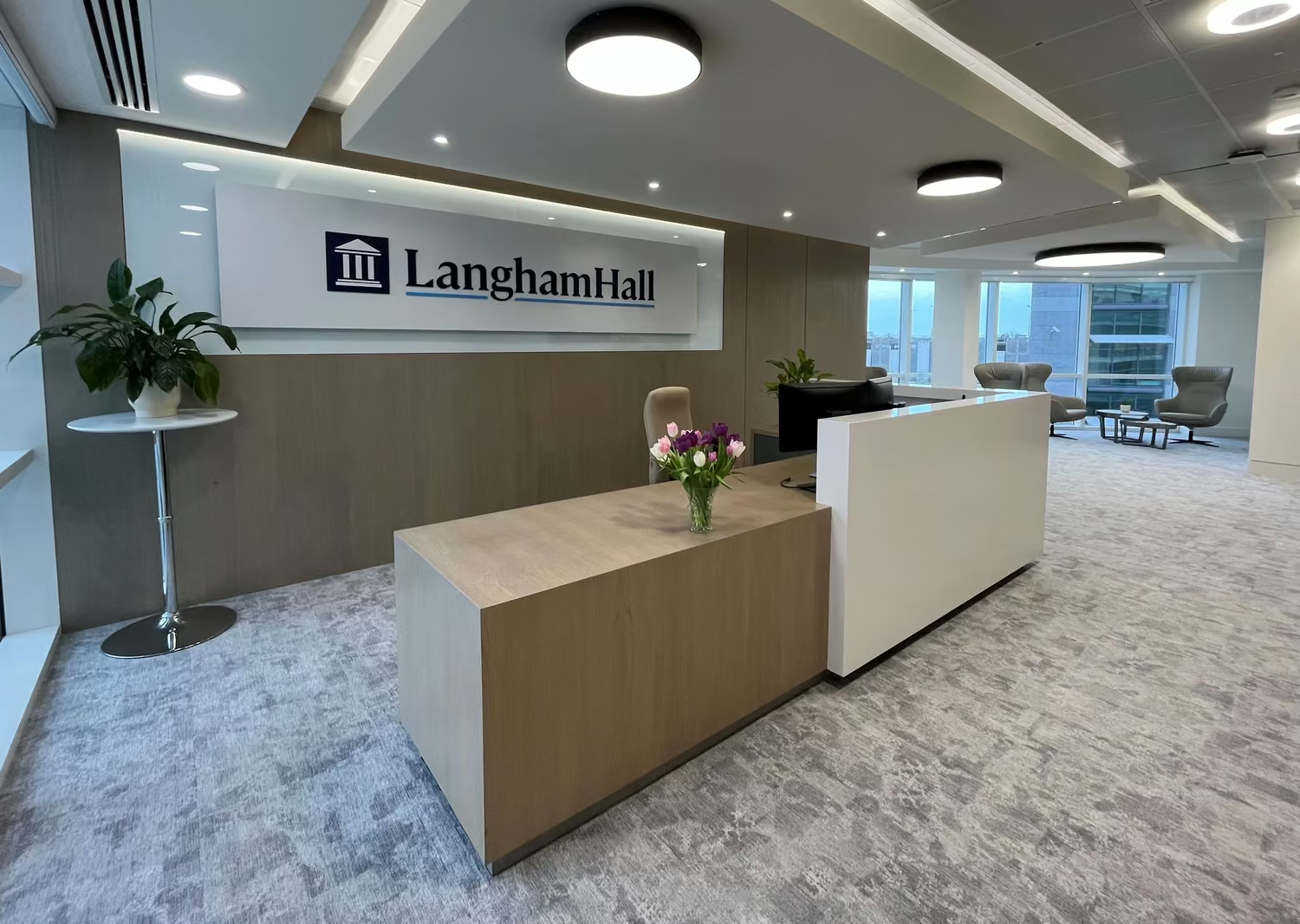
Langham Hall expands Guernsey presence with new office move
Langham Hall is pleased to announce an important milestone for its Guernsey office: a move to a new, larger state-of-the-art premises in Admiral Park. The move reflects the firm’s continued growth and belief in Guernsey as a key jurisdiction for private equity, venture capital and real asset funds.
The new office spans 10,000 square feet and supports Langham Hall’s ever-growing team of 70 staff, who provide fund administration services to leading fund managers. The move enhances the firm’s ability to deliver best-in-class investor reporting, accounting and regulatory compliance support to an expanding global client base.
Jon Young, Partner and Head of Guernsey said: “This is an incredible milestone for the Guernsey business, which has grown from one to 70 staff over the past nine years. This move emphasises our long-term commitment to our team, our clients and Guernsey as a key jurisdiction for funds. The new office provides our team with a fantastic working environment and further space for growth whilst ensuring our clients continue to receive market-leading service. We continue to invest in our team, technology and infrastructure to support our clients’ needs.
Spinouts and emerging managers have been key drivers of our growth in Guernsey and we have seen significant momentum in this area in Q1 alone, supporting some fantastic first-time fund launches. We expect to see this trend accelerate through 2025.”
Langham Hall’s continued investment in Guernsey and other key global financial centres reinforces its position as a trusted fund administration partner to over 150 fund managers globally, overseeing $180 billion in assets under administration.

Langham Hall supports bd-capital’s €430 million fundraise
Langham Hall is pleased to announce it has supported bd-capital in the successful final closing of its second fund, bd-capital Fund 2 (“Fund 2”). Despite a challenging fundraising environment, Fund 2 closed at €430 million – more than 20% over its target of €350 million – after less than twelve months in the market.
This raise brings bd-capital’s assets under management to over €800 million. The strong demand for Fund 2 reflects the confidence investors have in bd-capital’s operator-led, multi-sector investment strategy, which continues to grow its appeal to mid-market businesses across Europe.
The Fund secured commitments from a diverse base of institutional investors, including insurance companies, pension funds, sovereign wealth funds and family offices. It attracted capital from across Europe, the Middle East and North America, with a significant proportion coming from the US, demonstrating bd-capital’s growing international reach and reputation.
As bd-capital continues to execute its pan-European, multi-sector, operator-led strategy, Langham Hall has provided fund administration services, ensuring seamless structuring and operational support throughout the fundraising process.
Jon Young, Partner and Head of Guernsey said: “It has been a pleasure to work with bd-capital on this milestone fundraise. It’s an incredible achievement to exceed their fundraising target in difficult fundraising conditions but their unique approach and dedication to their cultural values resonates well with everyone they partner with. It’s been an honour for the team at Langham Hall to have been involved with Andy, Richard, Alice and the entire bd-capital team since their launch in 2020.”
Andy Dawson, Managing Partner at bd-capital said: “Fund 2’s successful final close reflects not only the strength of our investment strategy but also the strength of the partners who have helped us achieve it. Langham Hall has been a fantastic partner to us, delivering incredibly high-quality support with precision and efficiency. By being brilliant at fund administration, they have allowed us to focus on the job of investing and creating value.”
bd-capital was advised by Houlihan Lokey (global placement agent), Weil, Gotshal & Manges (legal counsel) and Carey Olsen (legal counsel).

Langham Hall expands global partnership as it strengthens leadership across key markets
We are pleased to announce that we have expanded our global partnership with the promotion of four senior professionals. These appointments strengthen leadership across key financial hubs and reflect the firm’s continued investment in expertise, long-term client relationships and scalable growth.
Alongside these three partnership promotions, Langham Hall has recognised talent across the business, with a further 17 being awarded long term incentives and a total of 144 employees promoted worldwide, reinforcing the firm’s commitment to internal progression and long-term value creation.
Langham Hall now has 14 partners globally, each directly leading expert teams and ensuring senior-led client service, technical precision and deep market insight across private equity, real estate, infrastructure and debt.
Newly appointed partners
- Richard James (UK) – As Head of UK, Richard oversees the firm’s UK fund administration business. He joined the business in 2024 and was previously Global CFO of Savills Investment Management, bringing deep expertise in financial strategy, governance and operations.
- Joseph Hindi (USA) – Appointed in 2023 to lead Langham Hall’s US expansion, Joseph has been instrumental in scaling fund administration and accounting services.
- Christian Mohr (Luxembourg) – A core architect of Langham Hall’s AIFM Luxembourg business, Christian has deep private equity and real asset expertise. With a background in audit and over 15 years of experience, he enhances the firm’s regulatory and governance capabilities across Europe. He joined the business in 2018.
A selective, structured path to partnership
Becoming a partner at Langham Hall involves a process which is highly selective and merit-based – reserved for the most talented professionals in the field. Unlike corporate structures where promotions can be tenure-based, Langham Hall ensures that each partner is a practitioner and leader, directly overseeing a team of experts and maintaining high-touch client relationships.
This latest round of promotions reflects Langham Hall’s commitment to quality, long-term partnerships, and independent growth. As a partnership-led firm, Langham Hall prioritises senior access, technical depth and fast decision-making – ensuring clients benefit from the best expertise in the industry.
Investing in people, expertise and technology
Langham Hall’s success is built on deep industry expertise, a relationship-driven approach and seamless technology integration. The firm combines expert leadership with innovative fund services, ensuring that clients receive precision, transparency and scalable solutions.
Rob Short, Managing Partner said: “At Langham Hall, we don’t just grow in size; we grow in strength. Each of our new partners has demonstrated exceptional leadership, technical expertise and a commitment to long-term client success. Their promotions reinforce our ability to deliver high-touch service across global financial centres while remaining independent, client-focused and technology-driven.”

Break the bias – Women in finance International Women’s Day 2022
As we celebrate International Women’s Day, we spoke to Rachael Lyon, Head of Fund Administration - UK who shared her experience of establishing her career in a male dominated environment and her recommendations on how to break the bias for young women entering the workforce.
About 15 years ago, I was in a meeting with my boss and about 10 others. At the start of the meeting, we were all giving our business cards and people started to arrange them so they knew the names of everyone at the table. However, by about 6 business cards in, we were all getting very confused and had no idea which person had given which card.
My boss jokingly said “well, at least we all know which one Rachael is”. I froze as I had no idea why he had said it. I suddenly felt very self-conscious and awkward. But as I looked around, I realised what he meant. I was the only woman in the room.
I am sure this is something that many women in the Real Estate world have encountered. This was 15 years ago, and things haven’t really changed much. Most of my meetings are still very male dominated.
Like many women, I have felt that I wasn’t good enough and had to work harder to be listened to and taken seriously. We put ourselves down and don’t put ourselves forward for promotions, new job opportunities and pay rises as much as our male counterparts and as a result our careers suffer, and we earn less.
Gender equality in the workplace is not only about getting more women in a male dominated industry, but also about breaking down gender stereotypes for both men and women to put people on an equal footing. Having equal opportunities and access to tools and experiences to build confidence in the workplace.
During my career, I have been incredibly lucky with some of the other women I have worked with and have forged some very strong relationships. This has enabled us to build each others’ confidence and use our often-differing strengths together to have a great deal of influence in the organisations I have worked in.
As a senior woman at Langham Hall, I help mentor junior women to build this confidence and to break down some of the limiting beliefs that prevent us from showing what we can really do!
Whether deliberate or unconscious, bias makes it difficult for women to move ahead. Being aware of them is not enough, we need to act. At Langham Hall, we are working to get more women to join the industry, supporting our female staff to build networks and connect with other senior women to continue building their confidence, holding women only activities as well as ensuring our events are gender balanced.
If you are interested in a career at Langham Hall, reach out to our HR team or check the latest vacancies here.
Join our newsletter
By subscribing you agree with our Privacy Policy