LATEST INSIGHTS
Langham Hall supports Clipway on closing the largest-ever debut secondaries platform at $6.4 billion


UK Private REITs: Two years on
In April 2022, the UK implemented a new “private” real estate investment trust (‘REIT’) regime, which allowed fund managers to take advantage of the various benefits of REITs without having to undertake the more onerous listing requirement imposed since the beginning of the REIT regime in 2007. According to HMRC, there have been 29 private REITs set up since the regime was amended* and we expect to see the new regime continue to prove popular with fund managers as an alternative to using offshore structuring options.
What is a private REIT?
A REIT is a company limited by shares that invests in real estate, in order to primarily undertake property rental business. REITs are exempt from UK corporation tax on both income profits and capital gains, with tax being levied at shareholder level, meaning the tax impact on investors is similar to making a direct investment in the underlying real estate. This is particularly beneficial to tax exempt investors, such as sovereign investors or UK pension funds, who can claim exemptions on property profits received from a UK REIT.
How is a private REIT typically used in a fund structure?
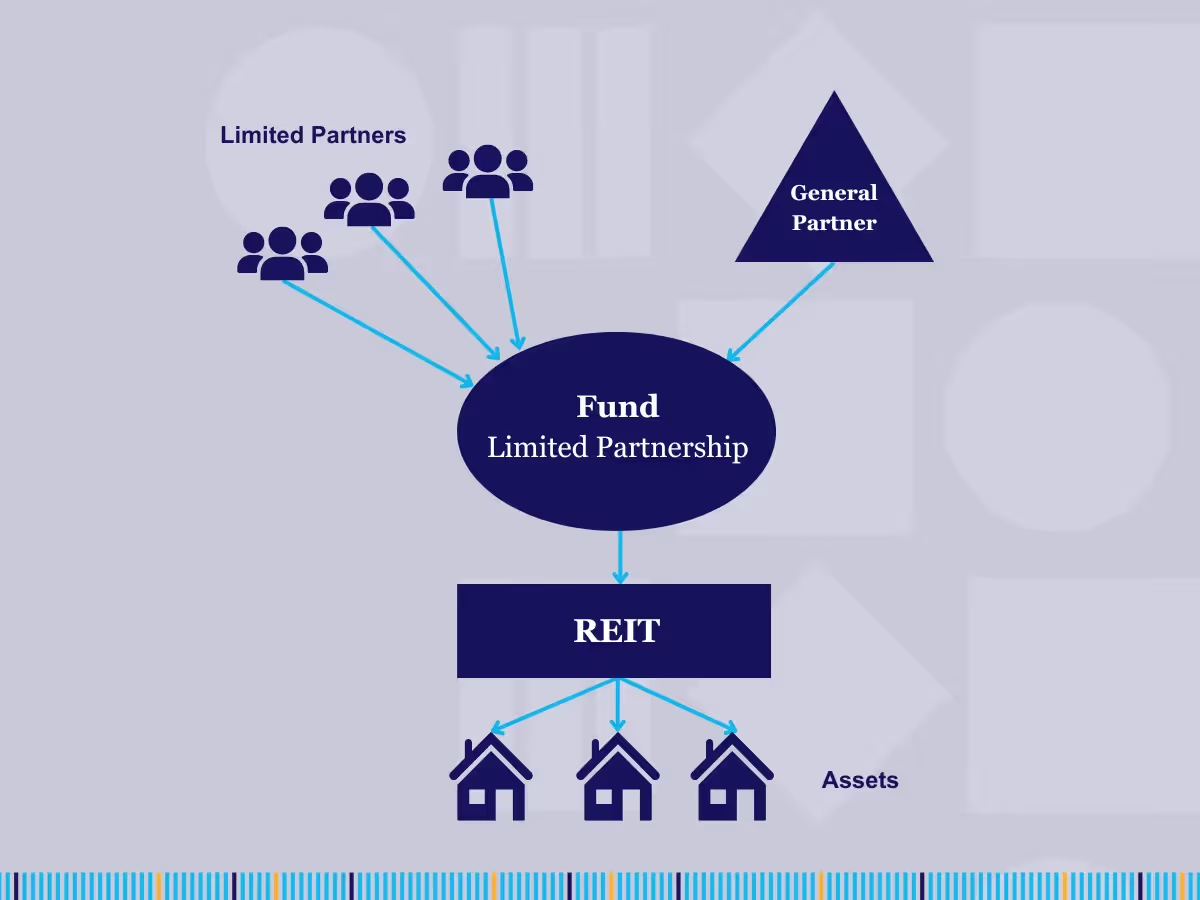
Traditionally, REITs were required to be admitted to trading on a recognised stock exchange, but the 2022 amendments have removed this requirement where at least 70% of the REIT’s ordinary share capital is held by institutional investors. Importantly, other commonly used fund structures (such as authorised unit trusts, or English limited partnerships) that meet a genuine diversity of ownership (‘GDO’) test are themselves considered an institutional investor for the purposes of the 70% test. Furthermore, real estate consultant John Forbes, who was consulted by HMRC on the GDO amendments, said that the rules on this have recently been made even more flexible, allowing ownership by parallel fund vehicles too. Using fund vehicles that meet the GDO test provides an attractive option for fund structuring, and in our experience a number of fund managers are exploring using a partnership structure to admit investors, with a private REIT held directly beneath.
This type of structuring has been commonly used elsewhere, for example in the US, for many years now, so is well understood by global institutional investors.
What are the requirements to hold REIT status?
To maintain private REIT status, managers should be aware of several conditions that must be met for a company to qualify for and continue to hold REIT status, including but not limited to;
- Property Income Distribution (‘PID’): a REIT is required to distribute no less than 90% of its property rental income as a dividend. This income is not taxable at the REIT level but is subject to withholding tax on distribution. Any other profits (e.g. interest receipts or property trading profits) are subject to UK corporation tax. Generally, an experienced fund administrator will work closely with a specialist tax advisor to ensure compliance with the PID requirements.
- Close company test: Companies are considered “close” if controlled by five or fewer participants This is not permitted for REITs. However, the new regime allows REITs to be close for the first three years and can be close if held by an institutional investor.
- Property business: a REIT must hold at least three properties, with no single property representing more than 40% of the value of the REIT. The exception to this rule is where the REIT owns at least one commercial property valued at £20 million or more.
Operational considerations
The PID calculation is, in our opinion, one of the most important elements of running a private REIT. Failure to distribute enough of property income can result in a company potentially losing REIT status, and instead being subject to 25% UK corporation tax. Using an experienced fund administrator in conjunction with a specialist tax advisor minimises this risk.
Additionally, private REITs are also required to submit a quarterly CT61 return for each period in which a PID is paid, and a reconciliation for each accounting period of how distributions made in that period have been attributed. Again, working with a fund administrator that has experience in the operation of these structures is important here.
Finally, there is a “Holder of Excessive Rights” charge levied on any shareholder which is beneficially entitled to 10% or more of dividends or voting rights of the REIT, meaning a tax charge will be imposed on any distributions made to such a shareholder. The new regime relaxes this rule for shareholders who are entitled to gross payment of distributions, such as UK corporates and pension funds, allowing them to avoid having to fragment their shareholdings by use of multiple SPVs.
What next?
We expect to see a continued growth in the use of private REITs for holding income producing real estate in the UK, particularly as so many public REITs continue to trade at deep discounts to NAV. The ability to use a private REIT within a wider fund structure makes for an attractive option to fund managers and makes the UK increasingly attractive as a fund domicile. A private REIT may also be a good stepping stone to a listed REIT later. A pool of assets can be built up when the REIT is private with the REIT then being listed via an IPO at a more propitious point in the market.
Operating such structures comes with complexity, and we would urge anybody considering the use of a private REIT to speak to us about the operational aspects of running such a structure.
* As at 31 Jan 2024. Confirmed via a Freedom of Information Act request submitted directly to HMRC


Use of fund of funds structures by Family Offices
In the intricate world of investment, Family Offices stand as strategic agents managing the wealth and financial affairs of high-net-worth families. Their influence in the investment landscape has expanded and with their greater access to private markets, they’re now paving the way for a wider group of investors to tap into these opportunities through the establishment of Fund of Funds structures, often set up in jurisdictions with flexible fund regimes such as Jersey.
Private Equity funds present a potentially lucrative yet often exclusive opportunity, typically only accessible to institutional investors or ultra-high-net-worth individuals through large, established, Family Offices or wealth managers. Recently, we have seen a trend of Family Offices, equipped with significant resources and experience, opening up access to these funds by establishing a fund of funds program for a select portfolio of Private Equity investments. This provides access to these underlying PE investments for investors who would otherwise not have the chance, as well as generating liquidity for further or more diverse investment opportunities.
Jersey is one of the world’s major international financial centres and offers a range of fund types and structures. It is a stable, reliable, well-regulated and tax efficient environment for setting up fund of funds structures that aim to widen access to private markets, The Jersey Private Fund regime (‘JPF’), for example, means that family offices are able to set up a tax efficient vehicle, subject to light touch regulation in a relatively contracted timeframe. These family offices should also consider their own regulatory status as it relates to managing investments, particularly in the UK where they may be required to obtain direct authorisation or act as an appointed representative if they are either marketing to other family offices, or deemed to be advising on investments. Benefits of the Jersey Private Fund regime include:
- May be offered to up to 50 professional investors
- No limit on fund size
- Receives fast-track approval from the regulator in 48 hours
- No prior approval required from the regulator
- Open to ‘professional’ investors and/or those investing £250k or more
- Not required to appoint an auditor, subject to any AIFMD reporting requirements
- No requirement to issue an offer document, subject to any AIFMD/SFDR disclosure requirements
If you are considering establishing a fund or fund of funds structure specific operational expertise will be required. Our team has a wealth of experience in establishing Jersey fund structures, partnering with our clients from initial set-up and on-boarding to business as usual throughout the life of the fund.

The UK’s U-Turn on financial promotion amendments
On 31 January, the UK made amendments to the Financial Services and Markets Act, changing the thresholds for High Net Worth Individual and Self-Certified Sophisticated Investor status.
These amendments were met with harsh criticism by many in the venture capital and start-up community, arguing that these higher thresholds would have a significant impact on the funding of start-up companies, as well as on early stage private capital fundraising. These amendments were also seen to disproportionately affect women and ethnic minority investors who benefit from investment from these types of investors.
On 6 March, the UK reversed these changes, and reinstated the previous thresholds. In summary, this means to be considered a High Net Worth Individual, an investor must have;
- Annual income of £100,000 in the last financial year (down from £170,000)
- Net assets of £250,000 throughout the last financial year (down from £430,000)
In addition, the requirement to have made more than one investment in an unlisted company in the last two years to be able to self-certify as a Sophisticated Investor has been reintroduced. Further, the Company Director threshold has been reduced to £1m of annual turnover (reduced from £1.6m).
These changes will come into effect on 27 March 2024.

International Women’s Day 2024 – Inspire inclusion
Envision a world where gender equality is the norm, where biases, stereotypes, and discrimination are nothing more than echoes of the past. Picture a society that not only embraces diversity, equity, and inclusivity but also celebrates every unique difference. This is the future that International Women’s Day (‘IWD’) aspires to create in 2024.
The theme for this year’s IWD is “Invest in Women: Accelerate Progress.” At Langham Hall, we are proud to have an array of remarkable women leaders who have relentlessly pursued and achieved their ambitions.
As we celebrate IWD we spoke to two of our senior women in our Jersey office. Calli De La Haye and Claire Brazenall who share their career journeys.
Calli De La Haye – Head of People, Jersey
My professional journey commenced as a Career Advisor, where I had the privilege of empowering young individuals by fostering their confidence and equipping them with the requisite skills for gainful employment or further education. This experience paved the way for my transition into the recruitment sector, which subsequently ignited my passion for Human Resources.
Earlier in my careers, I spent some time at Santander Bank, where I embraced the role of a Business Partner, gaining invaluable insights into the intricacies of stakeholder relationships this drove me to pursue further qualifications in Human Resources.
Upon joining Langham Hall in 2013, I was entrusted with managerial responsibilities spanning Operations and Human Resources. My dedication and performance led to my progression to the role of HR Director. I am now Head of People, where I oversee the Human Resources, Marketing, and Executive Support departments. This role allows me to leverage my extensive experience and skills to contribute to the business’s success.
In my time at Langham Hall, I have seen many talented women rise up through the business to become part of our leadership team. Their demonstration of personal and professional development is truly inspiring.
Claire Brazenall – Head of Private Equity, Jersey
I left school at the tender age of 17 and headed to Aberdeen to study Law and German Law. After 6 years of hard(ish) graft I left clutching my law degree and my diploma in legal practice ready to start my traineeship at Dickson Minto WS. What followed was two years of work at the coal face of corporate law during the global financial crisis, splitting my time between Edinburgh and London and gaining invaluable experience in the private equity sphere along the way. I was lucky to work for, and alongside, some of the brightest legal minds in the industry.
I qualified as a solicitor in 2010 into an extremely challenging market for newly qualified lawyers, trainee retention rates were extremely low as the impact of the recession continued. After a fair amount of research, interviews, and a visit to Jersey I accepted a role in the funds team at Carey Olsen.
Over the course of my time at Carey Olsen I worked across real estate and private equity transactions and financings, fund establishment, closings, and ongoing regulatory advice. While at Carey Olsen I built close relationships with several administrators in Jersey including Langham Hall. I had always had a great relationship with the team here and found them to be fun, friendly, and responsive. When the time came to consider my next career move in 2020, I leapt at the opportunity to join Langham Hall as a Client Director heading up two of the fund administration teams. In January 2024 I was promoted to Head of PE and now lead our growing private equity fund administration department which is a great challenge that I am relishing getting to grips with.
Over the course of my career, I have had the opportunity to work with many strong female leaders who have inspired me to develop my own leadership skills. I am fortunate to count some of these women as my close friends and they continue to inspire me on a daily basis.
In 2024, I think we have shifted from the idea that the only way to progress as a female leader is to channel your inner ‘Miranda Priestly’ to a growing recognition that engaging with teams and bringing them with you yields more positive, fulfilling results for all and I am definitely in favour of that.
At Langham Hall, we are working to get more women to join the industry, supporting our female staff to build networks and connect with other senior women to continue building their confidence, holding women only activities as well as ensuring our events are gender balanced.
If you are interested in a career at Langham Hall, reach out to our HR team or check the latest vacancies here.

Langham Hall charity initiatives – 2023 wrap-up
Langham Hall is committed to giving back to the communities in which it operates. We champion our staff to be involved in a variety of activities to widen their life experiences and perspectives.
During the second half of 2023, our global offices challenged themselves with a range of charity and fundraising activities.
We looked back at their successes:
Jersey
Jersey continued their support for their chosen charities Jersey Hospice Care and Dementia Jersey.
They started the second half of the year by donating their monthly dress down collections to both the charities.
The office also took part in The Jersey Hospice Care Dragon Boat Racing (coming 7th!) as well as sponsoring the Santa Dash for the second year in a row.
They ended the year by manning the Dementia Jersey stall in town as well as helping wrap presents ahead of the festive season.
In total they raised £3,140 for Jersey Hospice Care and £1,000 for Dementia Jersey.
Guernsey
The second half of 2023 was a busy period for the Guernsey team. In July a group of six employees (and one dog) joined in the Gower Walk of Hope in aid of Guernsey Mind. August saw a bake sale and the Tower to Tower Walk and Run, both in support of Guernsey Alzheimer’s Association.
A team of five colleagues entered the Skipton Swimarathon in October swimming a very impressive 160 lengths in aid of Guernsey Mind and the Guernsey Youth Commission.
The team ended the year taking part in Beard Up! Challenge for local charity Male Uprising Guernsey whose aim is to raise awareness of male cancers and general wellbeing in the Bailiwick of Guernsey.
UK
The London office took part in Movember, where participants were set the challenge to either grow a moustache or aim to move 60k across the month, to represent the 60 me who commit suicide across the globe every hour. Thanks to their brilliant efforts the office raised over £2,700.
The team closed the year taking part in Christmas Jumper Day, which saw the office wear a fantastic selection off knitwear while raising over £350.
The office also made donations on behalf of the business and staff.
- Assistance with the Moroccan Earthquake relief efforts
- Assistance with the Libyan flooding relief efforts
- Donations to Motor Neuron Disease Association and Zarach (staff chosen charities)
Luxembourg
The Luxembourg office marked Breast Cancer Awareness month in October by designating two days of the month as ‘Pink Days’. Staff were encouraged to wear something pink and share a picture. Donations were made for every participant.
The team also assembled and joined the corporate football league organised by Social Goal, an NGO dedicated to making a positive impact for underprivileged children from diverse communities and cultures with the money collected by promoting employee well-being, engagement, and networking through corporate sports experiences.
The office rolled out an initiative to contribute to the wellbeing of others by donating blood or plasms to the Red Cross at any time, including working hours.
Colleagues also took part in Movember as well as matching employee contributions for the Moroccan Earthquake relief.
Asia
The Hong Kong office organised a steam workshop at The Hub HK. The charity provides support to families from disadvantaged backgrounds whose children needed to be taken care while their parents are at work. The centre provides support for children’s educational, physical and mental development.
We also encourage our staff across all jurisdictions to take on their own challenges and initiatives.
- Paul Tsang from London took part in the RNLI Tower Run
- Joseph Dennis from London took part in the Hever Castle Triathlon raising money for Macmillan Cancer Support
We look forward to all the different initiatives the teams have planned for 2024.
We are proud to stand together and extend a helping hand to those in need.


Langham Hall wins “Best Fund Administrator” for the mid-market sector (<$30bn AUM)
We are delighted to announce that Langham Hall has won the “Best Fund Administrator – GPs < $30Bn” category at The Private Equity Wire European Awards 2024. This category recognises best in class administrators working with GPs managing less than $30bn AUM.
Jon Young, Head of Guernsey said: “We are delighted to have been recognised with this award. Our partner-led, client centric approach makes us increasingly unique in this market, and we continue to support both emerging and established managers across Europe.”
The awards recognise excellence among service providers and private equity fund managers in Europe across a wide range of categories. Voting for the awards was conducted via an online poll of the entire Private Equity Wire userbase, where participants were asked to make their choice among the shortlisted firms in each category.
Thank you to all our clients for all their continued support.

National Apprenticeship Week 2024 – Starting your career
Deciding what path to take after school can be a daunting decision, do you continue onto a Sixth Form, go to college, or consider an apprenticeship?
Apprenticeships are an exciting option, where you get hands-on training while simultaneously putting the skills you learn into practice.
As we celebrate National Apprenticeship Week 2024, we spoke with Rushk Naqui and Teri Sandford.
Q: Why did you decide to do an apprenticeship?
TS: When looking to begin my career I was unsure on what path would be best. However, after plenty of research I found an apprenticeship would be the best way for me to learn and grow. I quickly came to realise that Financial Crime was the industry/role that I was most interested in and keen to learn more about. As an apprentice you get a chance to develop all areas of your work whilst gaining a qualification that helps you in your day to day work.
RN: From a practical perspective, an apprenticeship provided the platform to be able to support my family in a meaningful way in the immediate and near future. The apprenticeship model also created a structure and support system that surrounds me, which I was not guaranteed at university. I also found the prospect of being in an environment with world-class professionals inspirational and an opportunity to change my perspective.
Q: What kind of tasks have you completed / do you complete on a daily basis?
TS: On a daily basis I conduct Customer Due Diligence checks/ reports for the onboarding of all new internal clients and for counterparties on behalf of external clients.
RN: My role is to help uphold and expand the firms risk management and compliance functions. Some of the tasks include; Assessing all criminal, regulatory or adverse media reports related to our clients as well as studying the risk and regulatory landscape.
Q: What has been your biggest challenge during your apprenticeship so far?
TS: Balancing apprenticeship work with your day-to-day work can be challenging at times. However, this can be made easier by developing a timetable/ schedule to split your day to day from your apprenticeship. I personally found this developed my time management skills and allowed me to split my time appropriately and effectively.
RN: 14 months into my Financial Crime apprenticeship I was offered a 3-month secondment to the Regulatory Compliance team. Having to adapt to this new role while aiming to maintain the standards already set by the team was an enriching experience, my new tasks tested my capabilities and forced me to grow.
Q: What do you hope to be doing in five years’ time?
TS: I hope to have achieved my ICA Qualification and have progressed to a more senior level within the Financial Crime Team.
RN: I hope to have more responsibility, be more knowledgeable and become someone my colleagues can turn to for expertise.
Q: What’s the best piece of advice you could give to someone who’s looking for an apprenticeship?
TS: My recommendation is to research as much as you can to find an apprenticeship best suited to you within an area that you are interested in and keen to develop for your career. Also, keep an open mind when listening to and searching for opportunities.
RN: Take advantage of the support available. There are charities and organisations dedicated towards mentoring young people and assisting them at every stage of the apprenticeship process. I would not be in this position without the help I received from the wonderful people at these places.

European capital: Routes to market for Non-EU managers
Following a very challenging 2023, managers throughout the market are planning their fundraising strategy and timelines for 2024. Europe will be a key target for many. We are seeing a lot of interest already, including from managers who have never previously chosen to raise from Europe.
To summarise, for any non-EU manager looking to raise capital from Europe, there are only two routes in which you can “market” a fund in line with the prevailing AIFMD regulation. These are a) marketing a non-EU fund (typically Delaware) or b) marketing an EU fund (typically Luxembourg). This has been the position for 10 years. However, ahead of selecting either route, managers should strongly consider implementing a formal “pre-marketing” phase ahead of marketing. Since August 2021, pre-marketing in the EU now requires notification to regulators of the relevant country. By leveraging Langham Hall’s approval as a regulated AIFM in the EU, we can register for a pre-marketing campaign covering all EU countries. This is not possible for non-EU fund managers.
Hosted Pre-marketing is the fastest way to start speaking to investors. The chronology is as follows:
- Undertake pre-marketing;
- Undertake formal marketing by either:*
a. Marketing a non-EU fund via the National Private Placement Regimes (‘NPPR’) where accessible in that country; or
b. Marketing an EU domiciled fund via the EU marketing passport
*For structural reasons some managers may decide to use both options to maximise routes for bringing in European capital.
Hosted pre-marketing
This approach is being used as a pathfinder to European LPs. It facilitates conversation with LPs throughout Europe allowing discussion and document sharing (drafts only), up to but short of, executable subscription documents. This can also be conducted for a “potential” EU fund i.e. before establishment, as part of a global fundraise. In this scenario, pre-marketing is conducted for a potential Lux fund as part of the decision making process to determine what level of EU LP interest exists. Once pre-marketing has been completed and LP interest quantified, the fund sponsor/manager can then elect the more appropriate route of the two set out above to circulate final fund documents and admit investors.
Hosted pre-marketing can be up and running in 2-4 weeks.
1. Marketing a non-EU fund via the National Private Placement Regime (NPPR)
Marketing via NPPR is still the preferred route to admit investors from the EU for the majority of non-EU managers. It has been used successfully for 10 years, though some managers are yet to explore this option. It allows targeted country by country marketing, and is the required regulatory step to bring European investors into a non-EU fund. Certain regulatory requirements are triggered by formal marketing, including annex IV reporting (similar to Form PF) and a depositary-lite service (triggered by investors in Germany and Denmark). We provide these services from our London office.
Timelines vary, but managers should factor in 1-3 months to identify jurisdictions and get marketing permissions in place. Because of this, careful sequencing of pre-marketing and marketing applications should be considered so not to delay investor commitments.
2. Marketing an EU fund using a marketing passport
This requires establishing a (typically) Lux parallel fund usually managed by a Lux host-AIFM, with Lux fund administration and depositary services. It is a viable option for anyone raising more than $300m from European investors. While introducing some operational complexity, this is the natural progression for those with sufficiently strong LP demand or strategic needs and opens the fund for (professional) investors throughout any EU country.
The timeline to establish a Lux fund and getting a formal marketing approval to circulate final Lux fund documents and accept investors is usually circa 2.5 months.
A note on reverse solicitation
Managers considering European fundraising should bear the following in mind. In an increasingly competitive fundraising environment, reverse solicitation is less predominant than it once was. Reverse solicitation does not constitute a marketing strategy, and is undertaken at the sole risk of the GP and manager if it should be proven later that it was not a genuine reverse solicitation from the investor. EU regulators are putting more scrutiny on reliance on reverse solicitation and IR teams and placement agents are at risk of being in breach of EU regulations for pre-marketing or marketing a fund without regulatory approvals/notifications. GCs and CCOs are wary of investor DDQs increasingly asking about exposure to reverse solicitated investors. Case law now exists in which a distributor has been prosecuted for marketing activities relying on reverse solicitation.
If you are considering any European fundraising at all, please contact either Hanny Tirta (hanny.tirta@langhamhall.com) or Joe Hime (joe.hime@langhamhall.com) and we can walk you through the details of premarketing, NPPR and establishing and operating a Lux fund.
For all US fund administration requirements, please contact Joseph Hindi (joseph.hindi@langhamhall.com) our Head of US, based in New York.

FCA changes to HNWI and sophisticated investor qualifying criteria
Effective 31 January 2024, the Financial Conduct Authority (‘FCA’) Handbook’s thresholds on high net worth individuals (‘HNWIs’) and ‘sophisticated investors’ has changed. These changes are a result of the FCA consultation response on financial promotion order (‘FPO’) exemptions for HNWIs, which was published in November last year. These exemptions have not been substantively updated since 2005.
The new thresholds for each of the criteria are;
- High Net Worth Individuals: The net annual income requirement will increase from £100,000 to £170,000. Additionally, the threshold for net assets will rise from £250,000 to £430,000 or more.
- Self-Certified Sophisticated Investors: There will no longer be a requirement for individuals to have made more than one investment in an unlisted company in the prior two years. The exemption for company directors will change, requiring the company’s minimum annual turnover to be £1.6 million or greater, from a previous minimum of £1 million.
The exemption for individuals that have been part of a network of business angels, and/or have worked in the private equity or SME finance sector for two years remains unchanged.
If a person relies on the above categories for financial promotion of a non-retail fund, there may also be further regulatory considerations (e.g. the production of a Key Information Document (‘KID’), risk warnings, 24 hour cool off periods, etc) subject to appropriate legal advice as investors in these categories are still a sub-set of retail investors. Alternatively, these investors may very well elect to opt-up to professional status if they meet the MiFID criteria for professional investors for the most straight forward financial promotion.
For fund sponsors that are not regulated to distribute products to “retail” investors, it is important to note these new thresholds especially where they are relying on the relevant FPO exemptions in relation to these investor classes. It is important to note that these thresholds will also be applicable in the context of “friends and family” raises. Appointed Representatives undertaking financial promotions will also be required to consider these new definitions, in case they don’t have permissions to market to pure retail clients.
Blog updated 18/03 – These amendments were met with harsh criticism by many in the venture capital and start-up community and on the 6 March the UK Government reversed its decision. Read more here.
Join our newsletter
By subscribing you agree with our Privacy Policy